Every August, Early Childhood Australia asks us to pause and think about what quality early education gives a child. The conversation during Early Learning Matters Week tends to focus on pedagogy, on play-based learning, on the environments educators build, but underneath all of it sits a question we don't ask often enough: what has to be true for a child before any of that learning can happen at all?
Abraham Maslow answered a version of that question seventy years ago with his hierarchy of needs, the pyramid most of us learned about once and then filed away. At the base sit the physiological needs: food, warmth, rest. Directly above them sits safety. Only once those two foundations are in place does Maslow's pyramid make room for belonging, for esteem, and right at the top, for what he called self-actualisation: growth, curiosity, the confidence to try something and fail and try again.
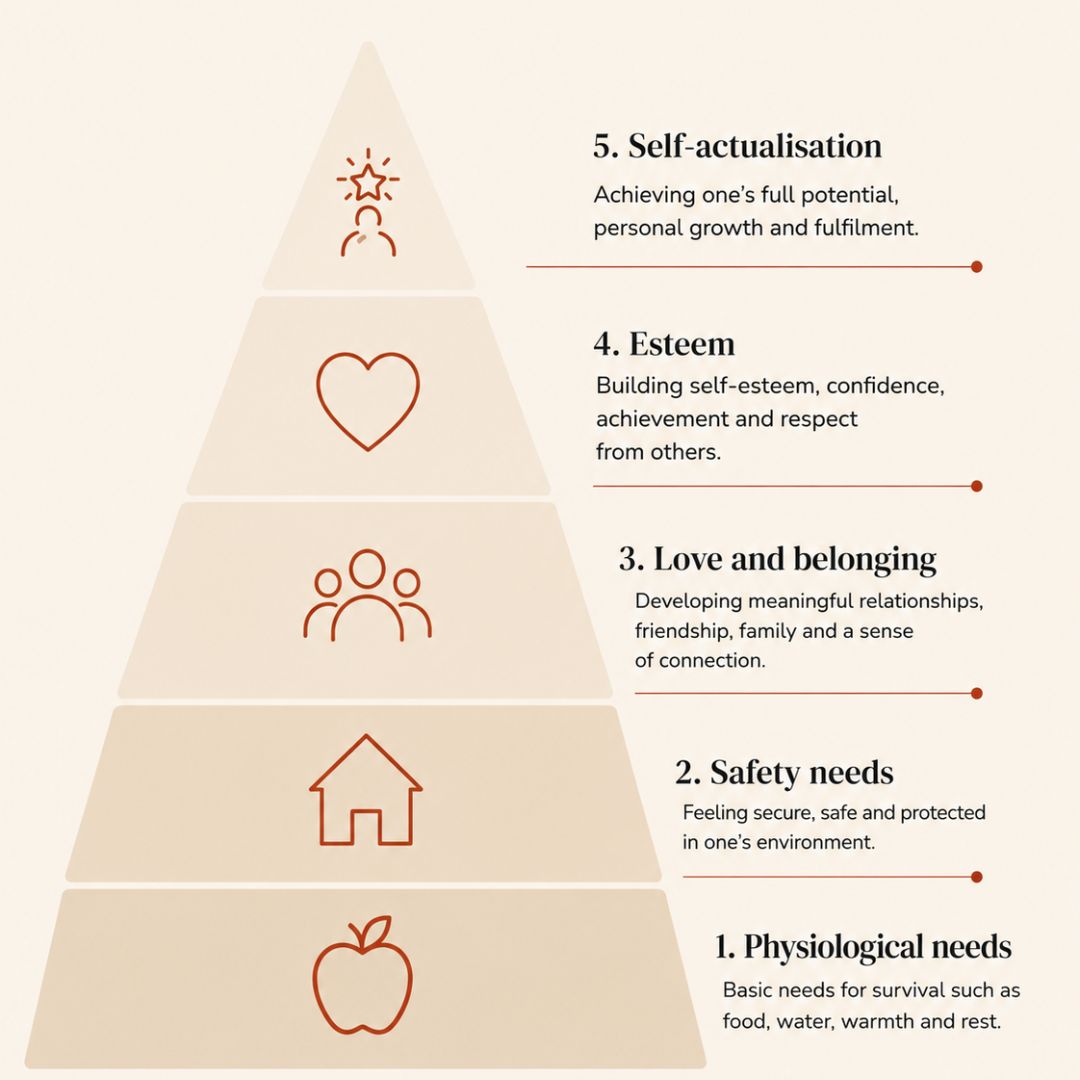
A child who does not feel safe cannot spend their energy on curiosity, because their nervous system is busy managing threats instead. Long before a toddler can stack a tower of blocks, or a four-year-old can lose herself in an imaginary game with a friend, their brain has already been asking a quieter, more urgent question: am I safe here? Early learning, in Maslow's terms, lives near the top of the pyramid. It cannot be reached without the base underneath it.
Contemporary developmental research has given us a more precise language for the same idea. Positive Childhood Experiences, or PCEs, is a body of work led by Dr Christina Bethell and colleagues that asks not just what harms a child, but what actively helps them thrive. Their research, published in JAMA Pediatrics, found that adults who reported high levels of PCEs in childhood had 72 per cent lower odds of depression or poor mental health as adults compared with those reporting the lowest levels, even when they had also experienced significant adversity.
The HOPE framework built from this research names four building blocks of thriving: stable relationships, safe and equitable environments, opportunities to engage with community, and room for emotional growth. Taking an interest in a child, supporting the family and connecting the family to community events are helpful ways early childhood settings can promote PCEs.
Notice how closely those four building blocks sit on top of Maslow's foundation. Safety was never meant to be the whole story. It's the floor that makes everything else possible. Relationships, engagement, growth: these are what a child builds once they know the floor is solid.
Early Learning Matters Week will rightly celebrate the educators, the environments, and the curriculum that make early learning possible. We'd only add one thing to that celebration: none of it happens without safety first. Every block tower, every story, every small act of self-directed courage in a classroom is built on a foundation an adult made sure was solid.
So this Early Learning Matters Week, we're asking something small of every educator, director, and parent reading this: before you plan the day's activities, take a moment to notice what safety looks like in your space. Name it out loud with your team, or with the child in front of you. That noticing, more than any single program or lesson plan, is where prevention really starts, long before anything needs to become an intervention.

Latest from SAFE.
Articles, explainers, national reform commentary and safeguarding system analysis - published as the conversation moves.