

Australia has just hardened its most significant child safety training mandate in a generation. By 27 August 2026,every carer and educator in the country must have completed nationally consistent child safety training. The obligation is clear. The infrastructure to support the people carrying it is not.
Sarah is in her early thirties. She has been a room leader at a long day care centre in outer suburban Melbourne for four years. She is Diploma-qualified and working toward her Bachelor. She chose child care because she genuinely loves the work. She is the person the other educators come to when they are unsure about something. She is, by any measure, good at her job.
She thinks of herself as an educator and a carer, not a mandatory reporter. That is how most people in her position think of themselves. But the obligation is there regardless of the title, sitting quietly in the background of every shift. In four years, Sarah has made one mandatory report. She has wondered, more than once, whether she should have made three.
Sarah's story is not unusual. It plays out across childcare centres every day, in every state, when educators carrying one of the most significant legal and moral obligations in the sector are left to carry it largely alone. That hesitation is not a character flaw. It is the entirely rational response of someone working without the right tools.
Australia has now made that obligation more explicit than ever before. And for the first time, there is infrastructure designed to genuinely support the people meeting it.
What changed in February 2026
The Early Childhood Legislation Amendment (Child Safety) Act 2025 came into effect on 27 February 2026, introducing mandatory nationally consistent child safety training for everyone working in early childhood education and care services regulated under the National Law. That means nominated supervisors, persons in day-to-day charge, educators, educator assistants, volunteers and students. Everyone.
The Foundation training is available now through Geccko, the Australian Government's official ECEC learning platform. An Advanced module drops in July 2026. The compliance deadline for all existing staff is 27 August 2026.
Critically, this new national training sits on top of existing state-based child protection and mandatory reporter training requirements, not instead of them. Carers and educators are now navigating two parallel compliance frameworks simultaneously, each with its own documentation requirements.
For approved providers, the stakes are explicit. Failure to ensure staff complete the training within the prescribed time frames is an offence under the National Law, with penalties applicable for non-compliance.
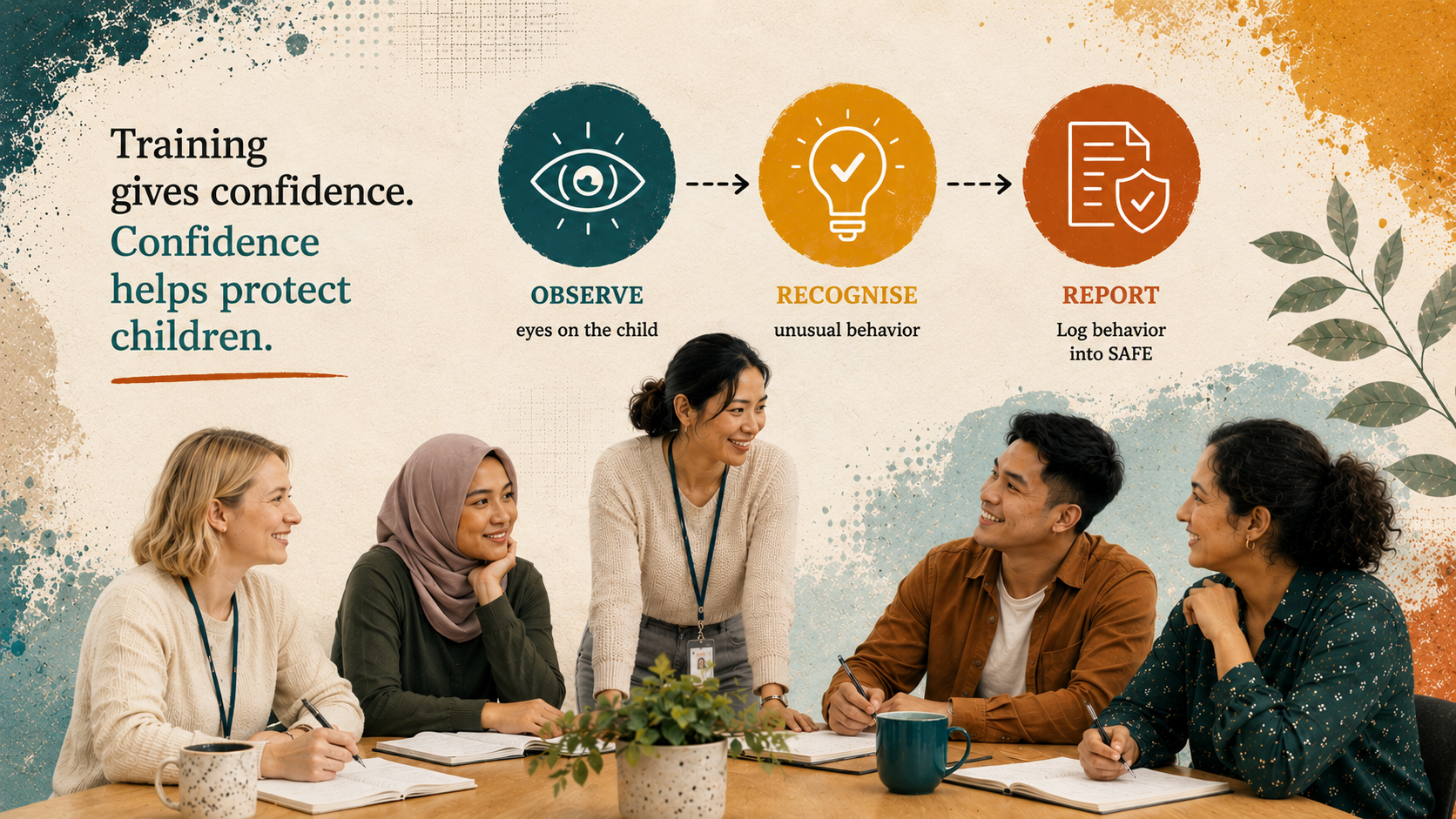
Training tells you what to do. Infrastructure helps you do it.
Sarah knows what the training tells her to look for. What she has never had is a tool that sits alongside her in the moment. One that connects what she noticed last Tuesday to what she noticed three weeks before, gives her a threshold rather than a guess, and tells her she is not imagining it. That kind of decision support infrastructure is what transforms a training obligation into a genuine capability. And it changes everything about what the new mandate can actually achieve.
Training teaches a carer to recognise the indicators of harm. It explains their reporting obligations. It gives them the legal framework. What it cannot do is sit with them at 9am on a Wednesday when a child arrives with a bruise they cannot explain, and help them know whether this is the time to make the call.
That gap between knowledge and action is where mandatory reporters are most vulnerable. It is where moral injury begins. It is also where children fall through.
Every carer who has ever hesitated before making a report wasn't failing in their duty. They were working without the tools to fulfil it.
The hesitation is not ignorance. Research consistently links mandatory reporter burnout and turnover to exactly this experience: the weight of carrying significant responsibility without adequate decision support. Educators leave not because they don't care, but because caring this much, without the right infrastructure, is unsustainable.
The Productivity Commission's 2024 inquiry into universal early childhood education and care described the ECEC workforce as being "in crisis, characterised by staff shortages, high turnover and stress," noting this was "of grave concern when the wellbeing and education of children in ECEC is linked with the qualification and wellbeing of the ECEC workforce." The same inquiry found educator vacancies had doubled since the pandemic. These are not peripheral pressures. They are the operating conditions our carers and educators are working in right now.
What good infrastructure gives carers and educators
The decision support infrastructure described in this article was built over 12 years from inside the child protection sector. It is not a compliance checklist. It is a behavioural pattern recognition platform designed to do what training alone cannot: give the person in the room the confidence to act on what they are seeing.
The platform's behavioural pattern recognition carries a 96% accuracy rate. For a carer standing at the threshold of a report, that is not an abstract statistic. It is the difference between hesitation and clarity.
The platform connects signals across time and context, identifying patterns that may not be visible in any single incident but become significant in aggregate. It provides clear escalation thresholds, a documented decision trail, and an audit record that protects both the child and the professional who raised the concern. For the employer, that record is also a demonstration of institutional due diligence.
For the educator, this infrastructure means they are not making this call alone. For the centre, it means the decision to report is supported, documented, and defensible.

The employer case: retention is an infrastructure decision
Australia's childcare sector is facing a workforce retention crisis that no wage subsidy or training incentive has yet resolved. The reasons educators leave are well documented: burnout, moral injury, the accumulation of carrying too much with too little support.
The numbers bear this out. The Productivity Commission reported 160 serious incidents per 100 ECEC services in 2024-25, up from 148 the year before and 139 the year before that. A consistent, worsening trajectory in a sector already stretched to its limits.
Childcare centre operators are now being asked to deliver a more rigorous, more documented, more compliance-intensive mandatory reporting environment than at any point in the sector's history. The question is whether our educators face that environment with better training and the same absence of infrastructure, or with the tools that make the training meaningful in practice.
Deploying this infrastructure is a compliance decision. It is also a statement to every carer and educator in our services about how seriously we take the work they do and the weight of the position it puts them in.
In a sector where experienced educators are scarce and turnover is expensive, the services that retain their best people will be the ones that invested in making the hardest parts of the job bearable. That is not a soft argument. It is an operational one.
"SAFE infrastructure is only good if it is used."
Ruby O'Rourke, Founder, SAFE.inc
The window is now
The August 2026 compliance deadline is eleven weeks away. The Advanced training module lands next month, starting a second compliance clock. Regulatory authorities are actively assessing child safety obligations under Quality Areas 2 and 7 of the National Quality Standard.
Sarah is still working in that long day care centre in outer suburban Melbourne. She is still good at her job. She deserves the tools to do the hardest part of it with confidence. So does every educator like her. This is the moment to ask whether the infrastructure our carers and educators are working within matches the obligations we are now legally required to ensure they meet.
The platform is called SAFE. It is currently in deployment with a select group of early childhood education and care services across Australia, developed specifically for the ECEC sector over 12 years. If you are a childcare operator, centre director, or sector leader who wants to understand what it looks like in practice, we would love to hear from you.
Know an educator carrying this alone? Forward this article. If you're the director or operator who just received it, get in touch at safe.inc/contact
Legislation & Legal Framework
- Education and Care Services National Law — Reporting Obligations — Department of Education, Australian Government
- Australian Child Protection Legislation by State and Territory — Australian Institute of Family Studies
- Child Protection Legislation by Jurisdiction — AIHW
Mandatory Reporting
- Mandatory Reporting of Child Abuse and Neglect — Australian Institute of Family Studies
- Reporting Requirements About Children — ACECQA
National Quality Standard
- Quality Area 2 — Children's Health and Safety — ACECQA
- Standard 2.2: Safety (Element 2.2.3 — Child Safety and Protection) — ACECQA
2026 Reforms
- Child Safe Reforms 2026 — What Approved Providers Need to Know
- NQF Child Safety Changes (PDF) — ACECQA

Latest from SAFE.
Articles, explainers, national reform commentary and safeguarding system analysis - published as the conversation moves.